How will SpaceX compete with AT&T, Verizon and T-Mobile in wireless?
SpaceX's purchase of 800 MHz low-band spectrum from Grain Management and what it means for the carriers, AST SpaceMobile, and tower owners
Wireless stocks are the biggest losers today as SpaceX gets ready to compete head-on with the carriers.
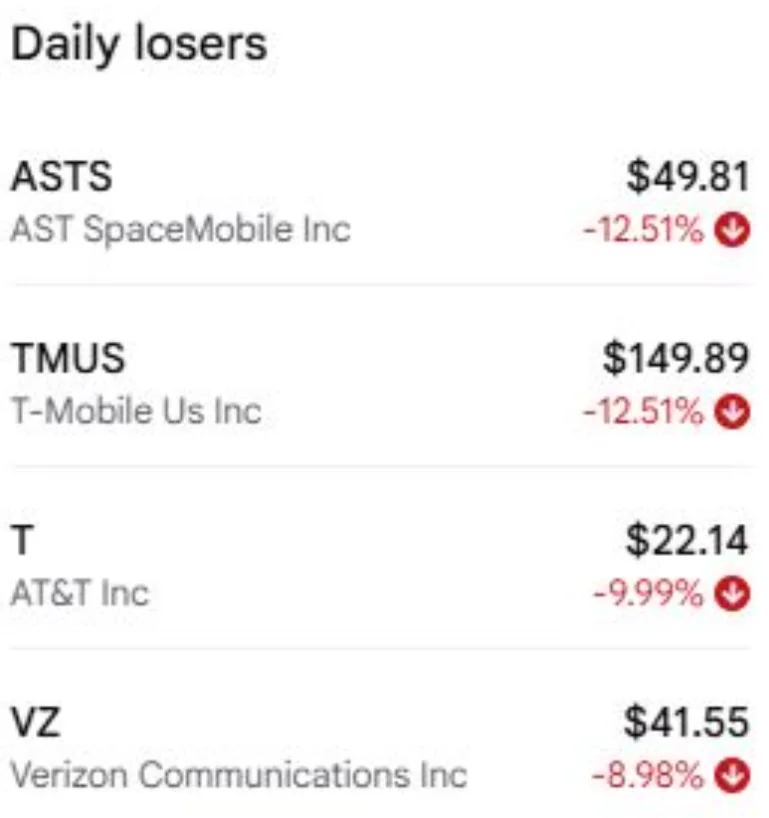
Today, SpaceX agreed to buy up to 14 MHz of 800 MHz low-band spectrum from Grain Management. Starlink Mobile says it wants to become a "major mobile carrier in the US," using satellites plus radios on the ground.
Execs have been talking about SpaceX's intentions in wireless and Grain's available spectrum for months, on podcasts, earnings calls, and news. Using CapRelay, I pulled together the story.
1. SpaceX took spectrum AST SpaceMobile was hoping to win
Per FCC filings, AST was already testing this exact Grain block, and Bloomberg valued the spectrum at about $6B. One AST podcast host said a SpaceX win would "turn up the fire" under the carriers.
2. Spectrum was SpaceX's main constraint
The three national carriers hold about 1.1 GHz of mobile spectrum. Before today, SpaceX had 65 MHz from EchoStar. Gwynne Shotwell says SpaceX intends to win "quite a few AT&T, Verizon, and T-Mobile customers."
3. The carriers are trying to shut SpaceX out
On their Q2 earnings calls, AT&T and Verizon ruled out letting satellite companies resell service on their networks, and Verizon reportedly turned down a wholesale deal. Telecom analyst Roger Entner points to independent resellers like US Mobile (1.1M customers) that are already working around that.
4. AT&T, Verizon and T-Mobile are forming a JV to rely less on Starlink
T-Mobile's head of strategic partnerships says only about 10-13 of Starlink's roughly 650 direct-to-cell satellites are over the US at any moment.
5. Cities are where this will be decided
About 80% of mobile data is used in cities and suburbs, and satellite signals struggle indoors. T-Mobile's CFO Peter Osvaldik says satellite is 0.0002% of its traffic. Low-band 800 MHz spectrum reaches inside buildings, which goes straight at that weakness.
6. Expect spectrum to get more expensive
If SpaceX bids in spectrum auctions, prices could rise for all three carriers, during a price war that already has plans at $15-50 per line.
7. Tower owners may be the winners
Crown Castle CEO Chris Hillabrant says about 90% of mobile use happens indoors or in vehicles, where satellite signals are about 10,000x weaker. SBA management puts only 2-3% of its portfolio at risk from satellite. If SpaceX builds out on the ground, it needs sites, which could make it a new customer for tower owners.
This research was done with CapRelay. Try CapRelay for free.