Is the SOXX selloff a buying opportunity? What the AI value chain is saying
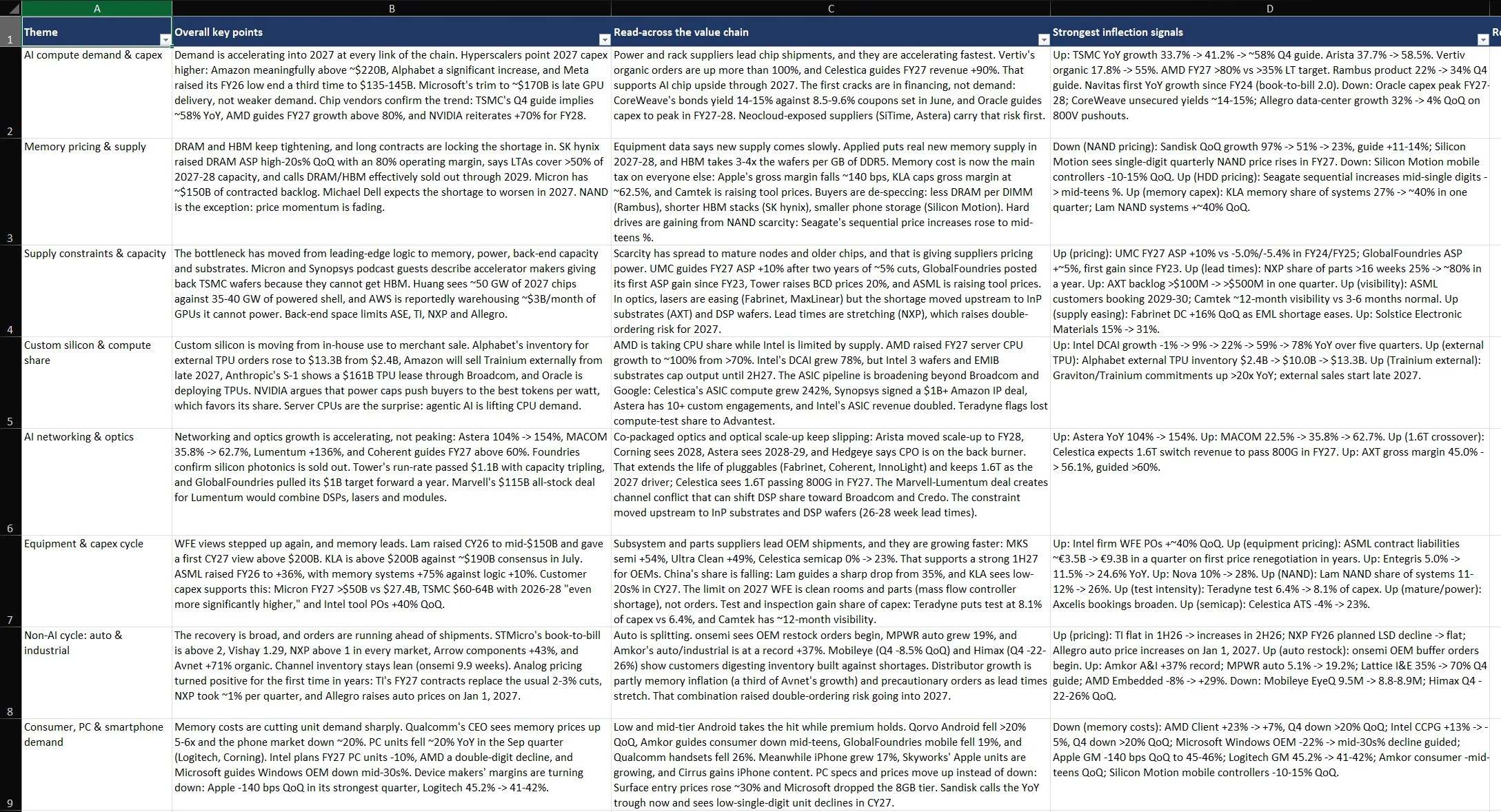
A read-across of TSMC, SK hynix, Amazon, TI, NXP and others shows AI demand still accelerating and shortages spreading, even as semiconductor stocks sell off
SOXX carnage today suggesting the AI cycle is over can't be more different from what industry execs are saying. Could this be a buying opportunity?
Highlights below from across the AI value chain.
1. AI demand is still accelerating
TSMC makes most of the world's advanced AI chips. Its revenue growth went from 34% YoY in Q2 to a guided ~58%. CEO C.C. Wei said AI accelerator growth will beat TSMC's prior mid-to-high 50s% annual forecast: "it probably will be higher."
Customers are still adding to their orders. Amazon's AWS backlog is $578B, more than doubling from $200B a year ago, and Amazon says FY27 capex will be meaningfully above ~$220B.
The GPU rental market shows the same thing. On SpaceX's Q3 call, Elon said SpaceX is "hounded relentlessly by every hyperscaler and by dozens of smaller companies to rent more of our compute," and its short-term contracts are renewing at higher prices. Even older GPUs are worth more: "even old computers like H100s renting for more than they rented when they were new."
Modal CEO Erik Bernhardsson, who buys GPU capacity from 25 neoclouds, said on a podcast that lead times are 3-4 months and customers absorb price increases easily.
2. The bottleneck is still memory
Memory makers simply can't add supply fast enough.
SK hynix says customers are asking for more than 2x the high-bandwidth memory it can supply today. Even so, it expects DRAM supply to grow only mid-20s% in 2027, because that is all its factories can add. It calls DRAM and high-bandwidth memory effectively sold out through 2029.
Memory is now holding back other parts of the chain. Apple said memory now limits Mac and iPad shipments.
Dell CEO Michael Dell said on a podcast: "Demand is growing faster than supply. It takes four years to build these factories."
3. The shortage has spread to boring chips
Older chips like power management and analog usually get cheaper every year.
But UMC guided FY27 prices up ~10% after cutting ~5% in each of the past two years.
Texas Instruments is negotiating FY27 price increases instead of its usual 2-3% annual cut.
At NXP, ~80% of products now take more than 16 weeks to deliver, up from 25% a year ago.
4. So what are markets worried about?
Laundry list of stuff, but two stand out:
- Dems making it harder to build data centers: will we need fewer chips, less stuff?
- And perennial concerns about overbuilding for demand.
But you'll notice that these concerns are a little contradictory. If the concern is overbuilding, then fewer datacenters means less risk of a supply glut.
These are highlights taken from a spreadsheet of 250+ reads from 90+ companies in the AI value chain, spanning 200+ sources (podcasts, news, earnings, etc.). Industry read-across like this is built with CapRelay. Try CapRelay for free.