Why hyperscalers are pulling back from leading open source models, and why AI-native companies are multi-cloud from day one
Google and Amazon still don't offer an API for the leading open source models, pushing AI-native software companies toward neoclouds
For investors around hyperscalers and neoclouds -- it's under-discussed how the hyperscalers seem to be pulling back from leading open source models.
And this is forcing AI-native software companies to become multi-cloud from day one.
The leading Chinese open source models have been available on specialist neoclouds for months now. Google and Amazon still don't offer an API for any of the leading open source models, that make up most of the volume on OpenRouter: DeepSeek V4, Kimi K2.7, GLM-5.2, Hy3.
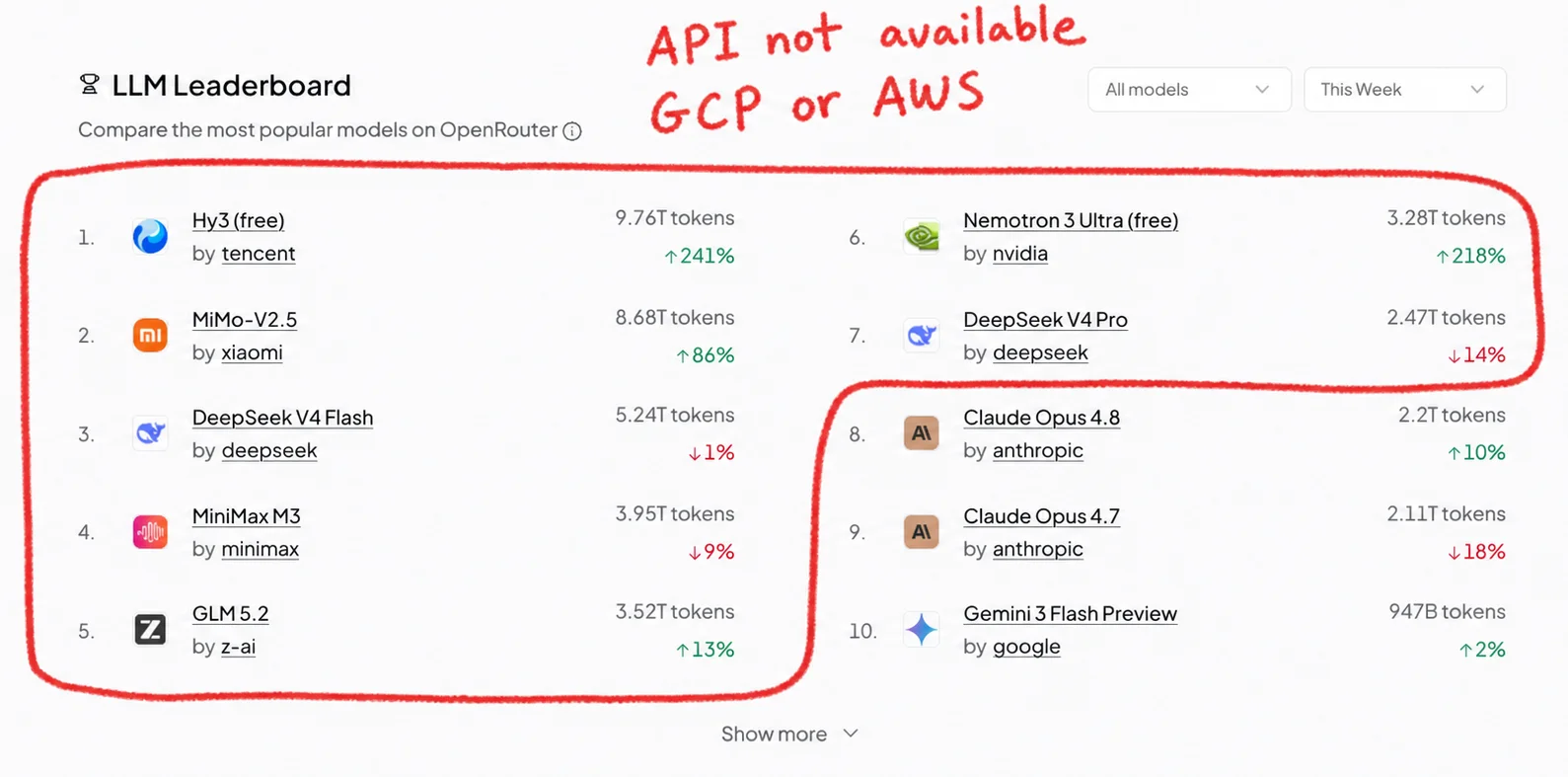
And with Kimi K3's release, the gap is set to get even wider.
This matters because AI-native firms like us at CapRelay test new models constantly, and we prefer open source models for post-training. As a result, we include neoclouds in our tech stacks.
Why's this happening? My views:
1. The hyperscalers are short on capacity
Every hyperscaler remains constrained on AI compute capacity.
AWS has agreements covering up to 5 GW of capacity for Anthropic and roughly 2 GW for OpenAI. Alphabet is balancing Google Cloud GPU rental demand against Gemini, DeepMind research, Search, and other internal products.
Given there's so much demand for compute, support for open-weight models competes with workloads that are already contracted, strategically important, or first-party.
2. Neoclouds are prioritizing software
Neoclouds are also supply constrained, but they view winning new AI-native customers as strategic.
In a prior post, I wrote about how neoclouds are moving up the stack to software. Serving new open models and letting customers post-train them is strategically important to Nebius, CoreWeave, etc.
This helps the neoclouds diversify their businesses and win new customers.
3. Providing a managed endpoint is pretty hard
These are enormous models. DeepSeek V4 Pro has 1.6T total parameters. Kimi K2.7 has roughly 1T, and K3 is even larger.
Building a good API endpoint requires optimized serving, capacity allocation, metering, security review, managing regional availability, quotas, and support.
Specialist clouds likely have some secret sauce here.
4. The result: The next generation of AI-native companies is multi-cloud from day one
The large tech startups of the 2010s era were born single-cloud, and grew to be fantastic customers for AWS and GCP.
We at CapRelay were born multi-cloud, because model access is incredibly important.
This is kinda painful, tbh. We have to learn auth models, deployment, and APIs across multiple clouds. To be clear, our primary clouds are fantastic -- anything we can do on AWS and GCP, we will.
But it's safe to say AI-native companies are less tied to a single cloud vendor than the startups of the past.
For tech analysts: Is customer captivity for the hyperscalers as strong as it is in the past? What happens when neoclouds move up the stack?
This research was done with CapRelay. Try CapRelay for free.