How EchoStar's failed wireless gamble ended with a stake in SpaceX
How EchoStar's failed fourth-carrier strategy led to spectrum sales to AT&T and SpaceX, and why capital allocation is the key debate
EchoStar is up 334% over the past year because it's set to receive a ~2% stake in SpaceX, which could be worth more than EchoStar's entire $31.6B market cap.
How did this happen?
EchoStar's path to riches ran through a failed wireless gamble.
Backstory
Charlie Ergen founded EchoStar in 1980 selling C-band satellite systems (the big backyard dishes people used to receive satellite TV before today's smaller consumer dishes). EchoStar launched its first satellite in 1995 and built DISH into a national satellite-TV provider.
DISH and EchoStar split in 2008. DISH kept the consumer TV business, or "pay-TV": subscription TV bundles customers pay for monthly. EchoStar kept the satellites and technology. DISH bought spectrum, later launching Sling TV in 2015 and buying Boost Mobile in 2020. Boost is a prepaid wireless brand: customers buy phone service without long-term contracts, typically at lower price points, and Boost pays AT&T and T-Mobile for network access.
The two companies recombined at the end of 2023.
The fourth national carrier that didn't work
Then Ergen tried to build a fourth national wireless carrier, using Boost's customer base and EchoStar's technology.
The plan was to use Boost's customer base, build a new cloud-based 5G network, move Boost customers onto that network, and stop paying and using AT&T and T-Mobile. This could bootstrap EchoStar into becoming a full wireless carrier, which could be a $100B+ opportunity.
EchoStar built much of the network required. The commercial side never caught up with the capex and debt.
By FY25, EchoStar had 7.5M wireless subscribers, but wireless revenue was only growing mid-single digits, and the segment still lost $495M at the operating level. EchoStar took $17.6B of impairments tied to the failed 5G and spectrum strategy.
The spectrum sales
The FCC forced EchoStar to pick another strategy.
In 2025, the FCC reviewed whether EchoStar was actually using its wireless spectrum: the licensed airwave rights needed to carry phone and data signals. That review collided with debt maturities and liquidity pressure. These forces pushed EchoStar to monetize the spectrum.
AT&T agreed to buy some of EchoStar's spectrum for $23B, and SpaceX agreed to buy the rest for $19.6B, including up to about $11.1B in SpaceX stock. SpaceX wants the spectrum for Starlink Direct to Cell, its plan to connect ordinary phones directly to satellites when terrestrial cell towers are unavailable.
Then, as SpaceX IPO'd, EchoStar found itself sitting on the most valuable asset it's ever had: SpaceX stock.
What EchoStar's future depends on
- Deal close. The AT&T deal had FCC/DOJ approval but had not closed, and the SpaceX deal is targeting a November 2027 final close. Until proceeds arrive, EchoStar's debt presents a real liquidity problem.
- Boost economics and legacy businesses. EchoStar still runs a mobile business, TV business, and a broadband business, which seem to be in decline. Ironically, EchoStar is a direct competitor to SpaceX's connectivity businesses, which are taking share!
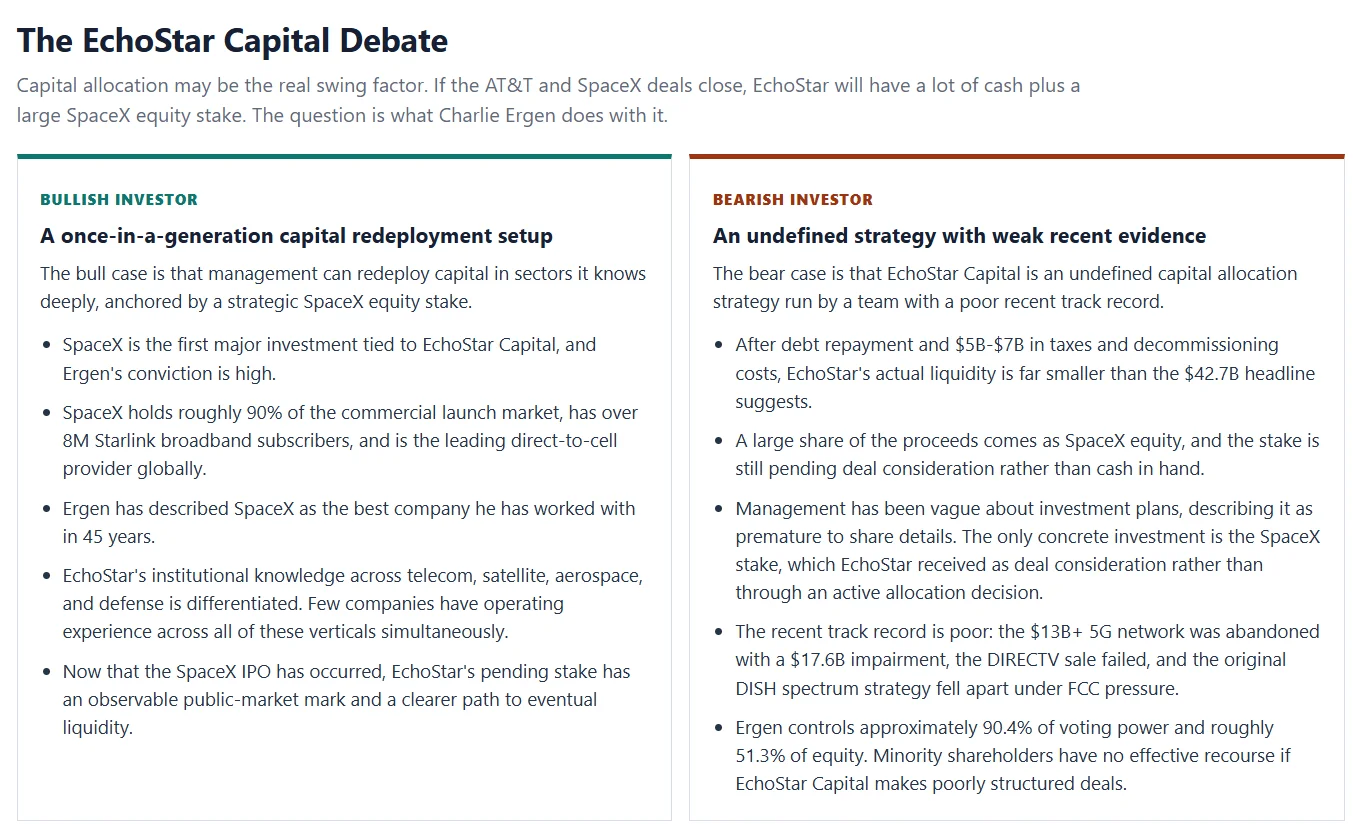
- Capital allocation and governance. This may be the real swing factor. If the AT&T and SpaceX deals close, EchoStar will have a lot of cash plus a large SpaceX equity stake. The question is what Charlie Ergen does with it.
EchoStar announced a new internal division called EchoStar Capital on November 6, 2025. The company has not laid out a mandate, but WSJ reported that EchoStar Capital would pursue new business lines using proceeds from the recent spectrum deals.
That creates the key debate: does EchoStar Capital become a disciplined telecom, space, and defense investment arm, or does it become a capital-allocation black box inside a founder-controlled company? The stock is probably discounting capital allocation somewhat.
EchoStar spent years assembling spectrum to launch a fourth national carrier, which didn't work. But along the way, EchoStar ended up with some valuable assets, which it traded for the most valuable asset of all: SpaceX stock.
This research was done with CapRelay. Try CapRelay for free.