Corpay: a 15-year compounder, transformed, now trading at ~15x earnings
How Corpay's shift from fleet cards to corporate payments created a cheaper, higher-quality compounder
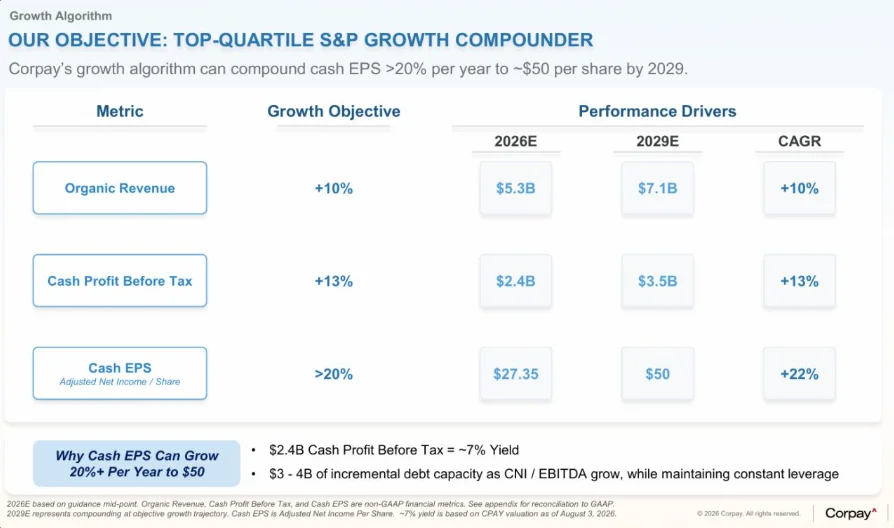
Payments company with a 15+ year track record of ~19% EPS compounding, growing ~10% organically, ~57% margins, now trading ~15x earnings/FCF after a transformation.
This is Corpay, formerly Fleetcor.
If you've studied compounders, you know this as a fleet card company, and you may have passed for that reason. But the business has changed.
From Fleetcor to Corpay
Fleetcor v1.0 helped companies pay for fuel. It still does that, along with tolls and other vehicle expenses.
Corpay is long-time CEO Clarke's v2.0. Over the last few years, he's built a much bigger business helping companies pay vendors and move money across borders. Hence the name change.
Corporate payments revenue went from about 21% of total revenue in 2021 to 41% last quarter. Corporate is growing 16% organically, vs. 10% for Corpay as a whole, mix-shifting the business favorably.
What the corporate payments business does
Say you're a mid-sized company paying hundreds of suppliers. Corpay can automate your invoices and payments, send vendors money electronically, and help with international payments and currency exchange. It earns fees on payments and spreads on currency conversions.
This is one of the businesses killing checks in B2B transactions, which might still be a quarter or more of overall B2B payments.
Corporate payments is a good business. Corpay says corporate payments retention is around 96-97%, versus 93% for Corpay overall. And the company's EBITDA margins are 50%+.
Capital allocation
CEO Clarke is an aggressive, shareholder-oriented capital allocator. Corpay deployed over $4B in 2025, including $782M of share repurchases and the acquisition of cross-border payments provider Alpha. Meanwhile, Corpay is selling smaller assets and directing investments towards corporates.
Why it's cheap
The reasons it's cheap seem researchable: float and rate dynamics in its corporate payments business. B2B and cross-border payments could change in structural ways over time. And vehicle payments is slower-growing, still large, with a little hair.
Corpay is one of several ideas that come up when I look for above-average quality companies that have undergone a transformation, trading cheap relative to organic growth. I run this search with an agent + CapRelay's MCP, which enables the agent to search through both financial stats and buy-side investment cases over time.
This research was done with CapRelay. Try CapRelay for free.
Not investment advice.