Why is C.H. Robinson buying RXO? The AI consolidation playbook in freight brokerage
C.H. Robinson's roughly $5.8B deal for RXO and how its AI and lean playbook could be used to consolidate a fragmented freight brokerage industry
CHRW is buying RXO, one of its largest competitors. CHRW headcount has been falling double digits % YoY for years now due to AI + Lean, and CHRW is taking that playbook industry-wide.
I used to cover industry consolidators at a hedge fund, and CHRW reflects a lot of that playbook.
Today, CHRW announced a ~$5.8B deal to put RXO's freight brokerage volume through the AI remargin CHRW play already ran on itself.
CHRW's AI and lean operating model
CHRW CEO Dave Bozeman (ex Amazon / Ford) took over CHRW in 2023, and put in a lean operating model, and an in-house bench of 450+ engineers focused on AI and automation.
The result: Share gains, continuous double-digit % headcount declines YoY, and adj. OPM jumped from roughly 19% in FY23 to mid-30s most recently. This is despite a weak freight market.
How CHRW's system works in practice:
- These engineers built proprietary AI agents across quote-to-cash: quoting, order entry, tendering, appointments, tracking.
- This means fewer people per shipment, cheaper buy-side carrier procurement with AI, tighter revenue management on the sell side, and volume that no longer needs proportional headcount.
- CHRW says it has 100+ AI agents now managing previously manual work.
By contrast, RXO's transformation remains earlier stage than CHRW:
- RXO is nearly breakeven on adj. EBITDA
- RXO has been losing share to CHRW
- RXO's adj. gross profit per employee was $164k in 2025, basically where CHRW sat pre-AI ($162k enterprise in 2023). CHRW is now at $331k.
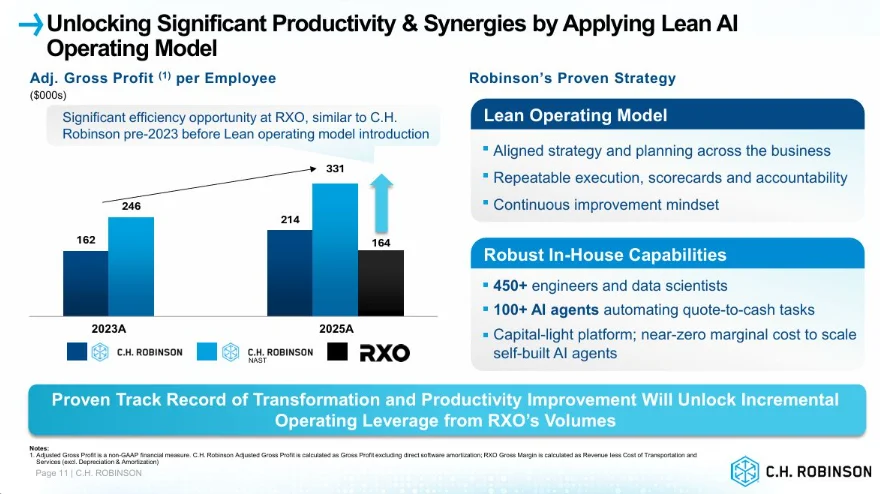
CHRW sees ~$300M of cost synergies.
Consolidating a fragmented industry
CHRW is the best-in-class operator in its industry. And with this comes the right to consolidate the industry and drive the same playbook.
Freight brokerage is fragmented, with thousands of tiny competitors. The product is matching shippers to carriers load by load. Barriers to entry are low, since relationships, local lane knowledge, and hustle still win a lot of freight. Asset-light means you can start a broker without a fleet. Shippers like to have multiple broker options. Scale helps, but hasn't forced consolidation yet.
The industry has tailwinds: broker penetration of for-hire trucking rose from under 10% in 2010 to the low-to-mid 20s.
The outlook for consolidation from here:
- The best operator in an industry deserves to run the whole industry. They can buy any other player and create value. This seems to be CHRW.
- Quote-to-cash automation and carrier matching are software problems with high fixed cost and low marginal cost once the agents work. Bringing new carriers onto this platform drives margin.
- Liability and insurance requirements are increasing in the industry -- recent verdicts mean that freight forwarders might have liability for truckers they dispatch (even though they don't own them!). This hurts small brokers first and drive share to larger companies with real balance sheets.
The pitch in short
CHRW figured out AI first and now has industry-leading margins and share gain momentum. CHRW is taking out a huge competitor today, and using this playbook to consolidate the rest of a very fragmented industry. Oh and the industry is probably below mid-cycle earnings power.
I use CapRelay's data to find and track industry consolidations like this across all listed companies. Try CapRelay for free.