Bending Spoons
IPO Briefing

An overview of the Italian Constellation Software and key investor debates, before its public listing

Updated June 11, 2026
Research powered by CapRelay, start a free trial in seconds at caprelay.com

The core flywheel: acquire, transform, reinvest

Buy underperforming digital assets, rebuild product and org, then redeploy cash into the next deal.

$1.31B
2025 revenue
51%
Q1 2026 Adj. operating margin
50+
acquisitions since founding
2.19x
Q1 2026 net debt / adjusted EBITDA

1. Acquire

Buy proven digital businesses. Annual enterprise value acquired scaled from $194M in 2023 to $2.01B in Q1 2026 alone.

2. Transform

Rewrite code, rearchitect cloud, redesign UI, reset monetization, and rebuild the org. CEO Luca Ferrari calls it 25% private equity, 75% technology company.

3. Reinvest

Operating cash flow grew from $59M in 2023 to $291M in 2025. Free cash gets reinvested into a 1,000+ target pipeline.

02 / 16

What Bending Spoons owns today

A portfolio of recognizable digital brands, monetized predominantly through subscriptions.

84% Q1 2026 revenue from subscriptions
12% Q1 2026 revenue from advertising
80%+ Q1 revenue from top 10 holdings
65% Q1 2026 revenue from North America
AOL Email, news portal, and search.
Brightcove Enterprise video hosting and streaming.
Eventbrite Event creation, ticketing, and discovery.
Evernote Note-taking and knowledge management.
Harvest Time tracking and invoicing.
komoot Outdoor route planning and navigation.
Remini AI image and video enhancement.
StreamYard Live streaming and video recording.
Vimeo Video hosting, management, and streaming.
WeTransfer File storage and distribution.
Tractive Pet location and health monitoring; excluded from F-1 operating data.
03 / 16

The core value creation engine:
A reusable investing and operating platform

The edge is disciplined underwriting, pooled talent, shared functions, and proprietary operating tools.

Selective talent

Roughly 0.04% hire rate from about 800K applicants in 2025, creating a small core team that can be redeployed across businesses.

Proprietary technology

Internal software standardizes pricing tests, product experimentation, data pipelines, recruiting, and AI-assisted development across the portfolio.

Shared horizontal functions

Recruiting, finance, legal, data infrastructure, customer support tooling, and monetization libraries sit above individual products.

Portfolio-wide resource allocation

Spooners and tools move to the highest-return bottleneck, so a breakthrough in one asset can become reusable know-how for the next.

04 / 16

The acquisition and value creation playbook

Remini is the clearest blowout success: a 2021 acquisition that became a much larger product by 2025.
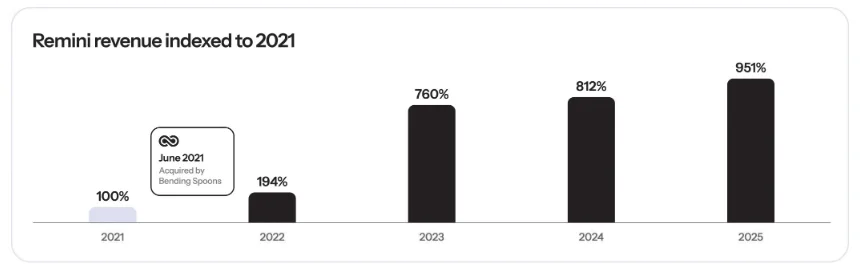
Remini revenue indexed to 2021

Target screen

$50M-$5B of revenue, subscription or advertising model, high retention, low paid-ad dependence, manageable AI risk, and room to improve.

Underwriting

Debate assumption distributions, run Monte Carlo IRR and NPV, with discipline to walk away if price doesn't hit hurdles.
Recent hurdles: 65% levered IRR and 25% unlevered IRR.

Post-close

Bending Spoons says post-acquisition growth was driven by a ground-up rebuild: simplifying around core photo enhancement, launching AI image features that created viral spikes, and shifting monetization toward subscriptions.

05 / 16

AI is a productivity lever

AI is compressing development cost and could solve the company's historical talent bottleneck.

  • Revenue per Spooner rose from $1.12M in 2023 to $2.57M in 2025.
  • AI makes product evidence cheaper by letting teams test rough prototypes before investing in polished releases.
  • The bull case is higher acquisition capacity and lower per-deal transformation cost.
90%

Q1 2026 code PRs AI-authored or co-authored

<10%

Q1 2025 code PRs AI-authored or co-authored

$2.57M

2025 revenue per Spooner

06 / 16

Part 2: the debates

1

Asset health

Are acquired businesses growing organically, or is growth driven by less sustainable factors like price, mix, and acquisitions?

2

Return runway

Can 65% levered and 25% unlevered IRR persist, especially as the platform scales?

3

AI

Is AI a driver of operating leverage, or is it a terminal value threat to the company's legacy software assets?

4

Owner earnings

Does adjusted operating income convert into cash owners can keep or reinvest?

07 / 16

Debate 1: are the acquired businesses healthy?

Is Bending Spoons buying cheap impaired legacy assets and harvesting price, or finding durable products with latent opportunities?

13% FY2025 organic revenue growth
6% Q1 2026 organic revenue growth
94% Q1 2026 net revenue retention
83% Q1 2026 new-customer revenue from organic channels

Bull case

Remini, Evernote, and StreamYard grew organically after acquisition. NRR is 94%, average subscriber tenure is 8.0 years, and 83% of new-customer revenue came organically.

Bear case

Reported growth is acquisition-led, Q1 2026 organic growth slowed to 6%. Growth from acquisition is much more competitive and less reliable than organic growth.

Does it even matter?

The portfolio is changing fast: 76% of Q1 2026 revenue came from businesses acquired after Q4 2024. AOL, Vimeo, and Eventbrite now dominate reported revenue.

08 / 16

The best proof point: Acquired products have grown organically
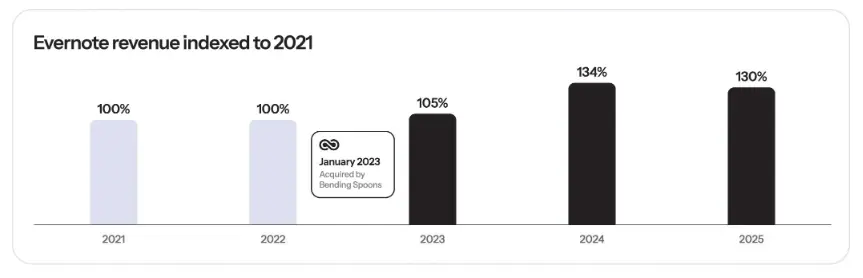
Evernote revenue indexed to 2021

Evernote stabilized and improved after acquisition, but growth involved higher average revenue per subscriber partly offset by fewer subscribers.
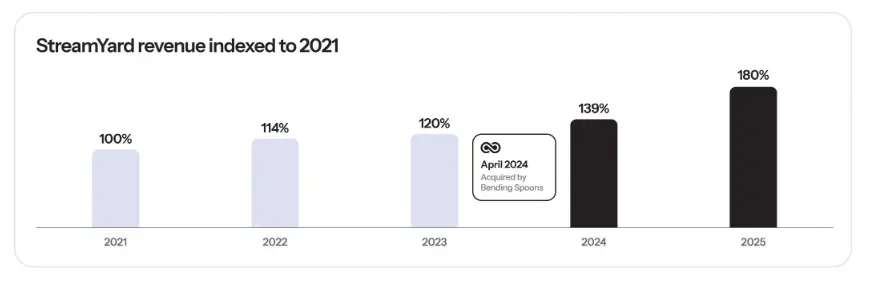
StreamYard revenue indexed to 2021

StreamYard grew revenue after acquisition driven by both subscriber growth and higher average revenue per subscriber.

09 / 16

Revenue acquisition mechanisms

Company-level growth is acquisition-driven, but new-customer revenue within the products is still mostly organic.
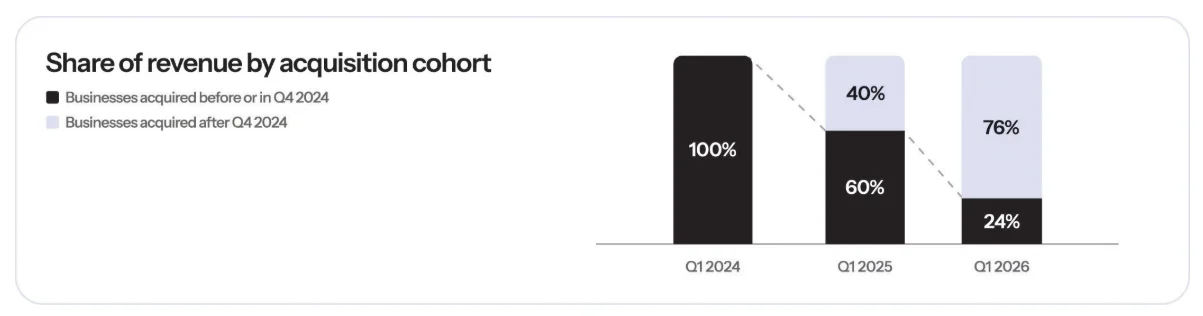
Share of revenue by acquisition cohort

Businesses that made up all Q1 2024 revenue were only 24% of Q1 2026 revenue. The old cohort grew in dollars, but new deals dominate the mix.

83% of Q1 2026 revenue from new customers came through organic channels, while advertising expense fell to 3% of revenue.
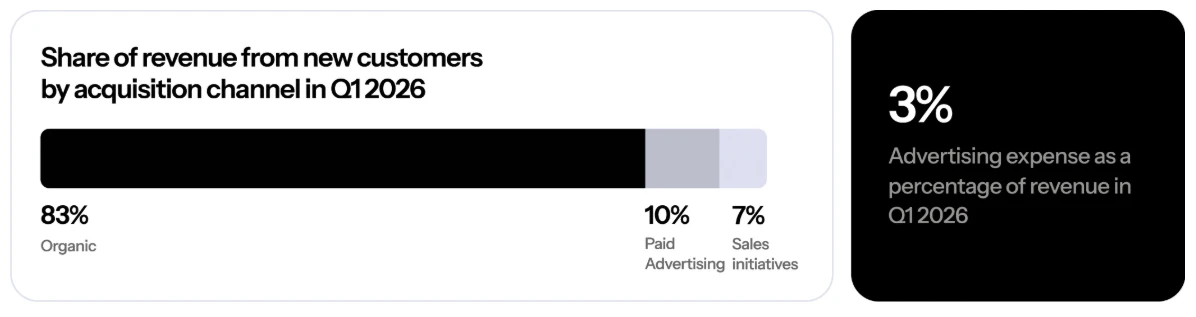
Share of revenue from new customers by acquisition channel
10 / 16

Debate 2: Will returns hold as deal size increases?

Three deals totaling roughly $3.3B in five months test whether Bending Spoons' historic returns hold at scale.
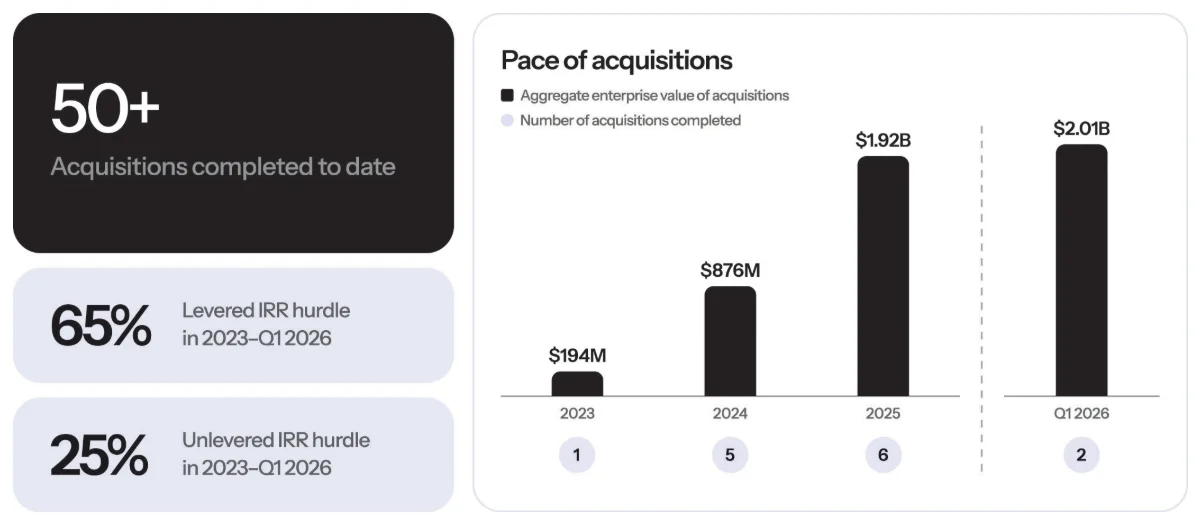
Bending Spoons pace of acquisitions and return hurdles

Bull case

Bigger #1 or #2 brands can be more efficient when transformation effort does not scale linearly with revenue.

Bear case

Bending Spoons is taking on execution, integration, AI, and leverage risk, together.

Runway

The target list exceeds 1,000 digital businesses, representing nearly $400B of aggregate estimated 2025 revenue.

11 / 16

Enterprise video is Bending Spoons' biggest bet to-date

Brightcove and Vimeo are larger, sales-led video platforms. Can the company improve product, retention, and go-to-market enough to earn the same returns?

First entry into enterprise sales

Enterprise buyer trust, reliability, roadmap execution, and sales productivity matter more than consumer UX or subscription monetization.

Larger checks

Brightcove was acquired for $233M. Vimeo was acquired for $1.38B, creating a larger, more complex video asset to transform.

Category pressure

YouTube, LinkedIn, Zoom, Cloudflare Stream, Wistia, and Kaltura pressure pricing, distribution, and differentiation.

Operating evidence

Brightcove has 1B+ weekly streams, stable retention, high satisfaction, and 19 major improvements post-acquisition.

Product and AI questions

AI dubbing, live clipping, contextual ads, 4K live, and a Video Cloud redesign need to convert into bookings and retention.

12 / 16

Debate 3: AI is both threat and operating edge

AI can cut costs, but poses a terminal value threat to some portfolio products.

Category-specific AI threats

Evernote competes with Notion AI, Copilot, and NotebookLM. AOL email, news, and search face AI-native interfaces. WeTransfer, Remini, and StreamYard face feature replication.

AI-driven product development

AI writes about 90% of code pull requests, raising acquisition capacity and reducing transformation cost. But does this also make Bending Spoons' portfolio easier to replicate?

Management's AI strategy

Bending Spoons says it screens for manageable AI disruption risk, relying on brand, workflows, proprietary data, and network effects.

The bet is that Bending Spoons can deploy AI faster than AI commoditizes its assets.

13 / 16

Culture, governance, and management

A talent-led model with unusual equity participation
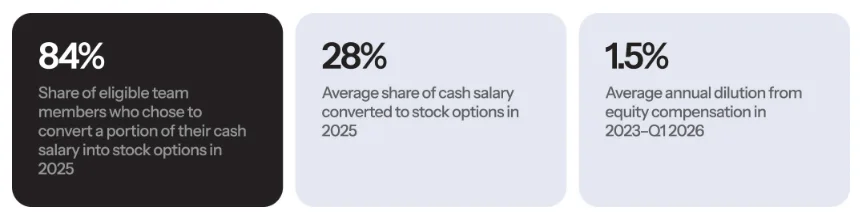
Bending Spoons compensation and equity participation
  • Talent as product About 800K applications for 286 hires in 2025; Bending Spoons emphasizes lean teams and high talent density.
  • Equity alignment 84% of eligible team members chose to convert part of cash salary into stock options in 2025.
  • Regulatory overhang CFIUS reviews for AOL and Eventbrite could restrict integration and directly interfere with the playbook.
14 / 16

Debate 4: what is owner's earnings?

Large gap between adjusted operating income and GAAP operating income + cash flow is a question mark

$613M

2025 adjusted operating income, equal to a 47% adjusted operating margin.

-$335M

Adjusted add-backs: $151M acquired-intangibles amortization and impairment, $85M transaction expense, $79M reorganization expense, and $21M other items.

$278M

2025 GAAP operating income after those acquisition and transformation costs.

$291M

2025 operating cash flow. This already reflects cash interest paid of $131M and cash taxes paid of $15M.

In 2025, operating cash flow landed much closer to GAAP operating income than to adjusted operating income.

$151M acquired-intangibles amortization and impairment seems defensible, as Constellation has done for decades. $85M of transaction expense and $79M of reorganization expense are more eye-catching, and may be recurring costs to keep the acquisition machine moving.

Acquisition spending is below operating cash flow: business acquisitions consumed $1.85B of investing cash flow in 2025.

15 / 16

A recap of key investor questions

Asset health

  • Are acquired businesses growing organically, or is Bending Spoons buying melting ice cubes?

Returns

  • Can historical targets of 65% levered and 25% unlevered IRR persist as the platform scales?

AI

  • Is AI a tailwind to profitability, or a threat to terminal value?

Owner earnings

  • What is real earnings power and margin potential?
Research powered by CapRelay, start a free trial in seconds at caprelay.com
16 / 16